
Need Help? Call Now
1-800-952-8444Free Consultation
Need Help? Call Now
1-800-952-8444Posted on February 09, 2026
For some people, a needle is a minor inconvenience. For others, it’s a source of real anxiety that can linger long after an appointment ends. Whether it shows up as unease before a blood draw or a deep-rooted fear that leads to avoidance, needle anxiety plays a quiet but meaningful role in how people approach healthcare.
To better understand that fear, we surveyed more than 2,400 Americans from every state about their experiences with needles, medical anxiety, and how those feelings influence their healthcare decisions. The responses reveal clear regional patterns, generational differences, and common triggers that shape how people react to injections and medical procedures.
By analyzing those survey results at both the national and state level, this study offers a clearer picture of where needle fear is most prevalent, how it affects patient behavior, and why those reactions matter when it comes to accessing timely medical care.
Our state-level survey responses show clear regional differences in how Americans experience and report fear of needles.
Nationwide, nearly one in five people (19%) say they’re either afraid or have an extreme fear or phobia of needles. At the other end of the spectrum, one in four people report no fear at all. Let’s take a closer look at which states stand out on either side of the fear spectrum.
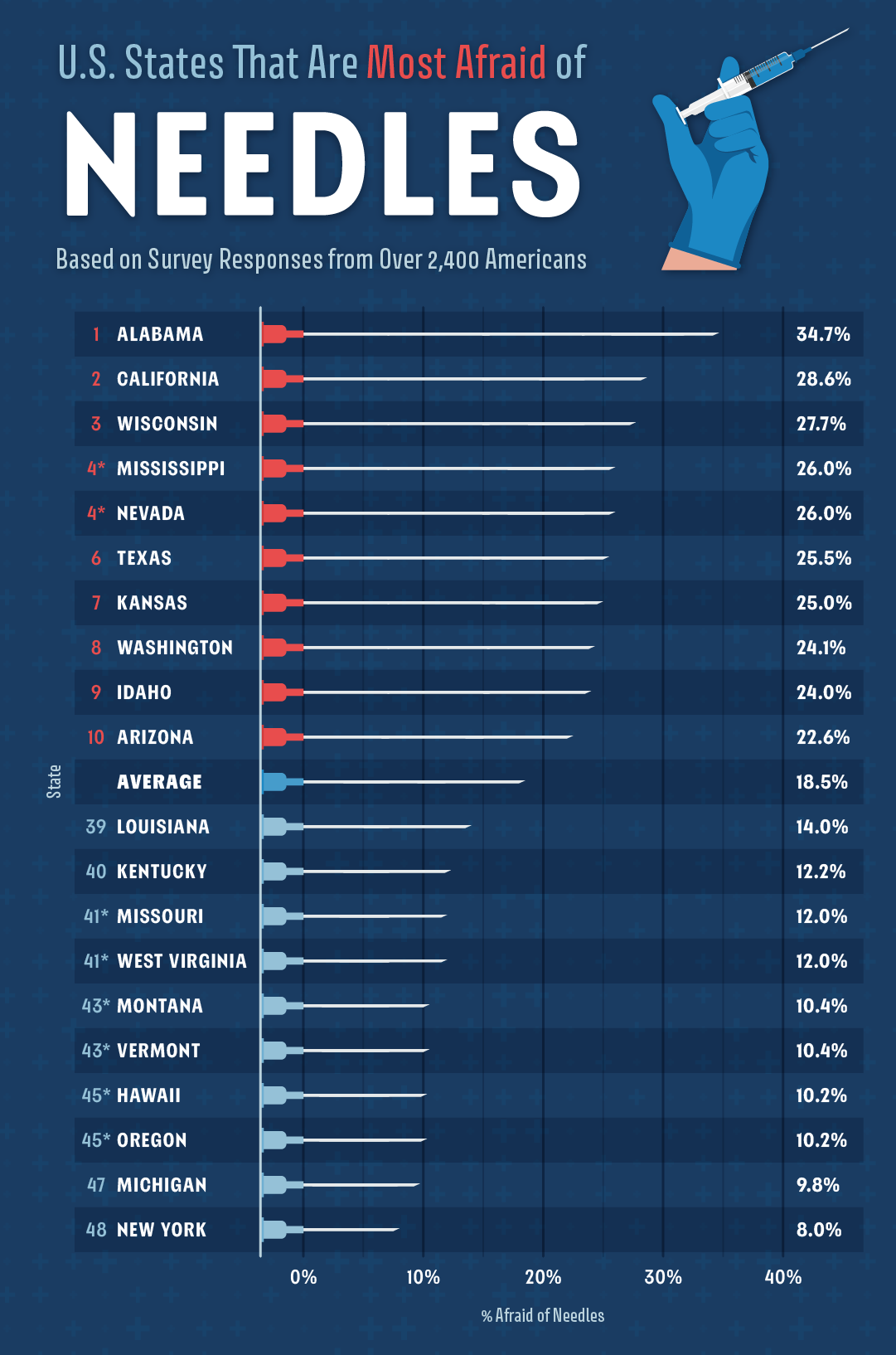
In several states, more than a quarter of residents report being afraid or extremely afraid of needles:
Two additional states fall just above the one-in-four mark:
In these states, needle fears aren’t a fringe concern. A sizable share of residents report anxiety that could make routine medical procedures feel intimidating or overwhelming. When that level of discomfort is common, it has the potential to influence how often people seek care, how long they delay appointments, or whether they follow through with recommended tests and treatments. We’ll explore more of the potential impacts later.
At the other end of the scale, several states report much lower levels of needle-related fear:
In each of these states, fewer than one in ten residents say they’re afraid or extremely afraid of needles. That lower level of anxiety may make it easier for patients to engage with preventive care, attend follow-up appointments, and complete procedures that rely on injections or blood work.
The data shows that fear of needles isn’t evenly distributed across the country. Where that fear is more prevalent, it can shape how people approach medical care in the first place. Next, we’ll look at how needle anxiety influences healthcare decisions and why delayed or avoided care can carry serious consequences.
Fear of needles doesn’t stop at discomfort. For many, it shapes how they interact with the healthcare system, from routine checkups to long-term treatment plans. Our study shows that trypanophobia is both fairly common and can be consequential, with effects that extend well beyond the exam room.
Fear of needles often starts early and follows people into adulthood. As we observed earlier, 19% of Americans say they’re either afraid or have an extreme fear of needles, and one in four report no fear at all.
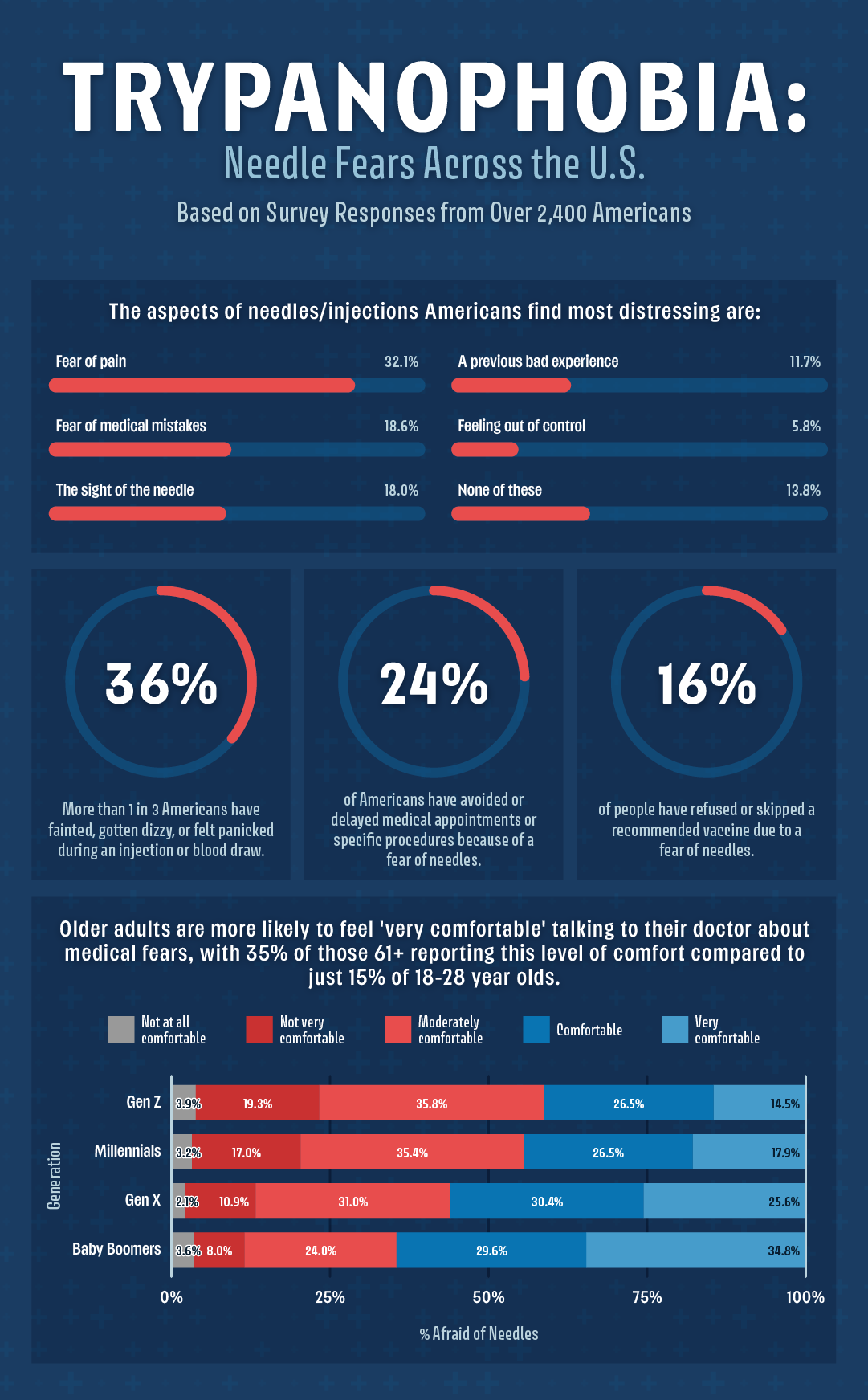
When asked what they find most distressing about needles and injections, respondents pointed to a mix of physical and psychological concerns:
Those fears are frequently reinforced by past experiences. More than one in three Americans (36%) say they’ve fainted, felt dizzy, or panicked during an injection or blood draw. These reactions are far more common among younger adults, with 43% of Gen Z reporting this experience compared to 19% of baby boomers. For many, the anxiety has deep roots, as 55% say their fear of needles began in childhood.
For a significant portion of the population, needle anxiety doesn’t stay theoretical. It alters real-world healthcare decisions:
These behaviors highlight how anxiety can compound health risks over time. Delayed care, missed preventive measures, and inconsistent treatment can allow otherwise manageable conditions to worsen.
A fear of needles often exists alongside general anxiety about medical care. Nearly 45% of Americans say they feel at least moderately anxious before medical appointments, including 22% who describe themselves as anxious or very anxious.
Communication plays a role in how that anxiety is managed. 21% of respondents say a healthcare provider has not taken their fear of needles seriously. Comfort levels also vary by age:
Despite these gaps, public sentiment leans toward empathy. 83% of Americans believe a fear of needles and injections is rational, while 17% disagree.
The data shows that trypanophobia is widespread, deeply rooted, and capable of influencing critical healthcare decisions. When fear leads to delayed care or missed treatment, the consequences can be serious. Understanding how and why patients avoid care is an important step toward identifying situations where better communication, follow-up, or medical oversight could have changed an outcome.
Fear of needles is more than a momentary reaction. The data shows that trypanophobia is a widespread, deeply rooted issue that’s shaped by past experiences, age, and broader medical anxiety and is capable of influencing critical healthcare decisions.
When fear leads to delayed care or missed treatment, the consequences can be serious. When patients avoid or postpone care, the risks can add up. Missed appointments, skipped vaccines, and unmanaged conditions can allow health issues to progress in ways that aren’t always obvious at first. In some cases, clearer communication, proper follow-up, or attentive care could have changed the outcome.
That’s where Weiss & Paarz comes in. When medical fears intersect with negligence or even malpractice, we work to determine whether harm could have been prevented and to hold providers accountable when it wasn’t.
This survey was conducted online using a nationwide sample of U.S. adults. Respondents were screened for state of residence to allow for state-by-state comparisons. A total of over 2,400 participants completed the survey, with quotas applied to ensure geographic balance. The questionnaire included 14 items measuring fear of needles, medical anxiety, and healthcare behavior.
Responses were collected anonymously, and data were analyzed to identify national trends as well as differences across states.
The survey ran for one month from December 2025 to January 2026. Alaska and Wyoming were excluded due to insufficient survey responses.
Disclaimer: The historical information and specific statistics displayed above are solely designed to provide general knowledge to the public and are being used as a part of attorney marketing. Cited statistics and statements were taken from the research of various independent websites (referenced above). Weiss & Paarz did not take any steps to replicate the findings of any sources used in this infographic, nor were the numbers or results displayed above independently verified by Weiss & Paarz.
You are welcome to use, reference, and share non-commercial excerpts of this study with proper attribution. If you cite or cover our findings, please link back to this page so readers can view the full methodology, charts, and context.
Call 1-800-952-8444